Leaving Corporate For Freelance Web Design: My Story
My fingers had no hesitation as I typed out the notice that would end my seven-year run in the corporate world.
The road that led me there was full of quiet pivots, long nights, and a deep, slow burnout I tried to ignore until I couldn’t anymore. I’d tackled every challenge in my role with as much kindness, grace, and quiet confidence as I could, but the truth was, I was done.
And even though I didn’t fully know what was next, I knew one thing for certain: I had to go.
From High Performer to Burned Out: The Part We Don’t Talk About Enough
I wasn’t the kind of employee people typically picture when they imagine someone preparing to leave their stable 9–5. I wasn’t disengaged. I wasn’t counting down to Friday. I wasn’t coasting.
I was one of the best in my role. (And I don’t say that lightly. I’ve always been someone who’s shrunk herself a bit, who’s played nice.)
I was organized, resourceful, collaborative. I fixed what was broken, made things clearer, created systems, supported my team. I genuinely cared.
And that, apparently, was part of the problem.
Because in a system where “doing more with less” is positioned as a strength, genuine care becomes a currency and those who care the most are often asked to give the most, with the least support in return.
I watched over and over again as people like me—people who paid attention, who wanted things to work better, who asked good questions—got labeled “too passionate” or “too sensitive.” And I felt the weight of it myself. The pressure to care, but not too much. To perform, but never push.
Over time, I stopped asking how to do my job better, and started asking harder questions:
Why am I so tired all the time?
Why does it feel like my nervous system is always on?
Why does this job feel like it’s swallowing my life?
Systems, Survival, and a Longing for Something More
I had been with the same company for almost seven years—on the same team, in the same structure. And while I had built a reputation as someone who could untangle operations, improve systems, and make processes run better, I started to realize I was stuck in a cycle that no amount of initiative could fix. Same meetings, same limitations, same quiet frustrations, same yearly review where nothing really changed.
I started noticing how much the structure was shaping me—not just my schedule, but my sense of worth, my nervous system, my ability to dream outside of what was on paper.
And here’s the tricky part: I didn’t want to do less. I didn’t want to care less. I just wanted that care to matter—to be seen, to be sustainable, to be taken seriously.
I wanted something different. Something I didn’t have to fight for every single day. Something I could build that would hold both my structure-loving, systems-thinking side and my creative, intuitive, design-obsessed side. Something that actually fit who I was.
Five Years In, I Knew It Finally Was Time
By year five, as I was inching closer to 30, something in me shifted. I kept imagining one of those old-school finger traps we used to play with as kids—the harder you pulled, the tighter the grip. That’s what it felt like trying to pull away from my job. Like the harder I tried to breathe, the more the system closed in.
I didn’t want to be in corporate. I never really did. And yet, there I was Googling “how to pivot careers without starting over,” wondering if it was possible to quit your job and still keep your identity intact. Wondering if I could build something new without throwing away everything I’d worked so hard to create. Wondering if I was even allowed to want more than just “stability.”
Cue the Gel Pens and Childhood Dreams
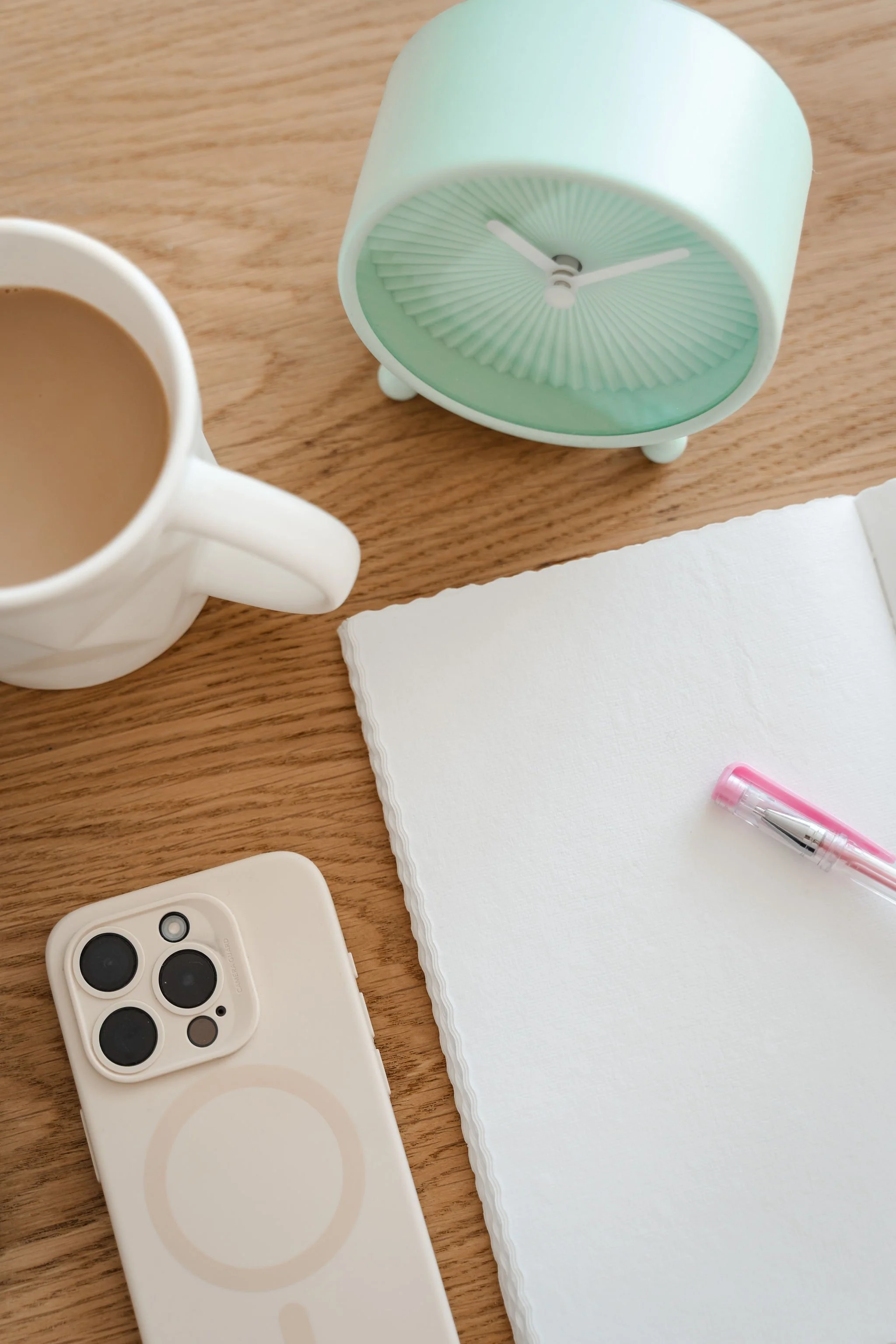
When I didn’t know what was next, I did what I always do: I looked backward to look forward.
Back to the kid who used to draw floor plans for fun. Who imagined outfits and styled notebooks. Who wrote vivid alien adventures in multi-coloured gel pens and curly cursive (and who got an A, but also a note from the teacher to “never do that again”—rude, if you ask me).
That girl didn’t dream of boardrooms or budget spreadsheets. She dreamed of living in a world of design; where function and colour could co-exist. She dreamed of building things that felt beautiful and useful. She loved colour and logic. Creativity and systems. She didn’t want to pick. And with web design, I realized, I didn’t have to.
Because while corporate had let me play in the systems and structure all day long, it never gave space for the design-obsessed, storytelling-loving creative part of me to speak up.
So I started asking: What would it look like to build a life where both parts of me got to lead?
From Side Hustle to Something Real
I’d been dabbling in web design on the side for years, long before I thought of it as a business.
During university, I ran a little design blog where I’d share bits of life and digital creativity, mostly for fun. Later, friends started asking if I could help with their websites. One thing led to another… and another… and soon, there was a spreadsheet tracking all of the design and strategy work I had booked.
At the beginning, it wasn’t flashy, but it was growing into something real. Real enough that, by year five, I made a quiet promise to myself: if I couldn’t find the career I wanted inside the company I worked for, I’d build it outside of it.
I wasn’t totally sure if I could turn it into a full-time thing. But I knew I had to try.
The Final Straw
The last two years in corporate felt like living two lives; spending days holding together a role that felt increasingly misaligned, and evenings building a business that felt like mine.
And then… came the moment. A particularly disheartening exchange with leadership left me with no doubt: no matter how much I cared, or how well I performed, I wasn’t going to be recognized in a meaningful or consistent way. And if I stayed, I’d keep losing parts of myself just to keep the peace.
So I wrote the email, sent the notice, and two weeks later, I handed in my badge and laptop.
We had a little charcuterie send-off (still grateful), and most of the team showed up (except my boss… classy). And while I wasn’t surprised, it was oddly affirming. Sometimes absence tells you everything you need to know.
What Really Happens After You Leave Corporate?
What has the shift from corporate to small business ownership really been like?
I quit just in time for Canada Day, which felt symbolic in its own way—a clean break, like summer break for adults. And to be honest, those first few weeks didn’t feel like I’d left my job for good. It felt more like an extended vacation, the kind where your brain’s still half-convinced you’re going back eventually, even if the paychecks have stopped and your work laptop is no longer sitting in the corner.
My body and brain were processing two very different things.
My brain—fueled by the years I’d spent running my web design business in the slivers of free time between work, dinners, social plans, and pure exhaustion—was convinced I had to use every single hour “productively,” before someone figured out I didn’t have to go back. I worked around the clock on my business, creating social calendars, connecting with other creatives, blogging like I’d just discovered the internet for the first time. I was excited, but in hindsight, I think I was still in flight mode—racing to build a sustainable business, without realizing I already had.
And while my brain was running at full capacity, my body was carrying something else entirely. Something heavier. The kind of exhaustion that feels like it lives in your bones. I couldn’t sleep properly. I had physical aches and pains, and I’m not usually someone who experiences chronic pain. But I knew what it was. It was burnout recovery—my body letting go of seven years of tension, frustration, and constantly having to shape-shift in a role where being myself rarely felt like enough.
What’s surprised me most about working for myself?
Honestly, the biggest surprise was how long it took me to feel like I was actually free.
I thought the day I quit would feel like a release, like all the boundaries I’d been craving would immediately unfold around me. But even after leaving, I found myself waking up with that Monday-morning anxiety. I still had phantom stress about the Tuesday afternoon team meeting that no longer existed. I still felt like I needed to be at my computer by 8:00 AM, even when my schedule didn’t demand it.
It turns out, leaving your 9–5 doesn’t instantly deprogram your nervous system. Freedom takes work, too.
And then, like flipping a switch—about a month in—I started feeling good. I could breathe easier. My body wasn’t screaming anymore. I could make my day fit me, instead of trying to make myself fit the day. I could hike with my dogs on a sunny Monday afternoon. I could rest and be productive. I felt more grounded, more creative, more in flow.
Did I make the right decision (and what does ‘right’ even mean anymore)?
Yes. No doubts at all.
But not because everything magically clicked overnight or because it was easy, but because it’s true. It’s true to who I am, what I want, and how I’m wired. And even though I was confident in the work I offer (I’ve got 7 years of operations experience, and 10+ in web, design, and SEO), that doesn’t mean I knew for sure people would book me.
That part—the wondering if your dream will be received—is the scariest. But they did book. Inquiry after inquiry rolled in. I got to work with the kinds of clients I used to dream about—smart, kind, intentional humans with big visions. I didn’t just get hired. I got trusted. And that feeling? That’s when I knew I didn’t just make the right decision… I made a real one.
Because “right” isn’t just about outcomes—it’s about alignment. And I’ve never felt more aligned.
How have my relationships changed?
This one still surprises me. I worked on the same team for nearly seven years. And while the role had high turnover, about half of us had weathered the same storms for most of that time. So I thought there’d be more lasting connection.
Aside from the sweet charcuterie send-off (which, again, delightful), I’ve only heard from a couple of people. And I don’t blame anyone. I know life moves fast. But it was a quiet surprise to see how quickly something that once felt familiar could dissolve.
On the flip side, I’ve started craving connection more than I expected. As a creative introvert, I’ve always cherished solitude. But now, I love connecting with fellow entrepreneurs, collaborators, or friends who just get it. And that’s something I never saw coming.
How do I define success now, and what did I have to unlearn to get here?
Success used to look like consistency, a full calendar, and reliable praise from leadership (even if it was followed by contradictory feedback five minutes later).
Now, success looks like alignment. It looks like working with people I enjoy, doing work I care about, and having space in my life to live—not just recover from the week. It looks like walking my dogs in the daylight. It looks like having time to cook a nice meal on a Wednesday. It looks like sitting in stillness and not feeling guilty about it.
And in order to redefine success, I had to unlearn a lot of things. I had to unlearn the idea that my worth is tied to productivity. I had to unlearn the reflex to always say yes. I had to unlearn the belief that “feedback” is always a reflection of truth, rather than someone else’s perspective (or projection).
Most of all, I had to unlearn the version of myself I became to fit into a space that wasn’t made for me.
Now, I’m my own boss. I don’t have to shape-shift to be accepted. I don’t carry the weight of being “too much” or “too sensitive.” I’m just me—and that’s enough.
What would I say to anyone standing at the edge of a similar leap?
If you’re standing at the edge, feeling like your body and your brain are trying to tell you something, please listen.
Not everyone has the option to jump without a parachute. I didn’t either. That’s why I built mine slowly, stitching it together on evenings and weekends while the rest of my life kept moving. But just because you can tolerate something doesn’t mean you should stay. You deserve more than tolerating your life.
If you know in your gut that it’s not working, whether its your work, your environment, your relationships, give yourself permission to explore something else. You don’t need to have a perfect plan. You don’t need a pro-con list that looks good on paper. Because your life isn’t lived on paper. It’s lived in your body, your energy, your joy (or lack of it).
Save your money. Build your support system. Start something on the side, if you can. But mostly?
Start believing in yourself.
You don’t need to be fearless. You just need to be honest.
Wrapping This Up (But Not Tying It in a Bow)
I didn’t leave my corporate job because I had a step-by-step blueprint or a polished business plan or some perfect, brave idea of what came next. I left because I couldn’t keep staying, not without slowly disappearing, not without continuing to dull down parts of myself that had been asking to speak up for years.
And if you’ve read this far—whether you’re still holding on to a job that’s quietly wearing you down, or already standing at the edge of a decision that feels too big to name—I want you to know that it’s okay not to have it all figured out, it’s okay to take small steps, and it’s okay to choose yourself before the world gives you permission.
Because leaving something that once felt like security isn’t about recklessness or running away—it’s about choosing something that feels like a fuller expression of who you are, even if you’re still figuring out what that looks like in real time.
I’m six months into full-time business ownership now, and while it hasn’t been without moments of doubt or discomfort or those quiet little fears that creep in when you least expect them, it has also been more affirming, more freeing, and more aligned than anything I’ve experienced before.
I’ve built relationships with people I never would’ve met otherwise, worked on projects that let both my creative and strategic sides show up at the table, and maybe most importantly, I’ve started living in a way that doesn’t feel like I’m constantly recovering from my own life.
And no, this journey isn’t wrapped in a bow. It’s still unfolding, still becoming. but for the first time in a long time, I know I’m on the right road, because this version of my work, my life, and my time feels like mine.